Sign This to Vote? Why We’re Watching the Election Commission
This article is based on publicly available information about the March 12 Anderson County Election Commission meeting. At the time of publication, the only public description of the proposal is agenda item V: “Language Change to Primary Application.” No draft language or supporting documents have been released by the Election Commission.
There’s a reason people attend Election Commission meetings in Anderson County.
It’s not because most people have spare time. It’s not because election procedure is thrilling. It’s because when the public is not in the room, too much can happen quietly, too late, and with too few answers… That is exactly why this matters.
At Thursday’s meeting (March 12th), Anderson County Election Administrator Mark Stephens is expected to push for a primary ballot application that would require voters to sign a declaration, under penalty of perjury, stating that they are a “bona fide” member of a political party or that they declare allegiance to that party and intend to affiliate with it.
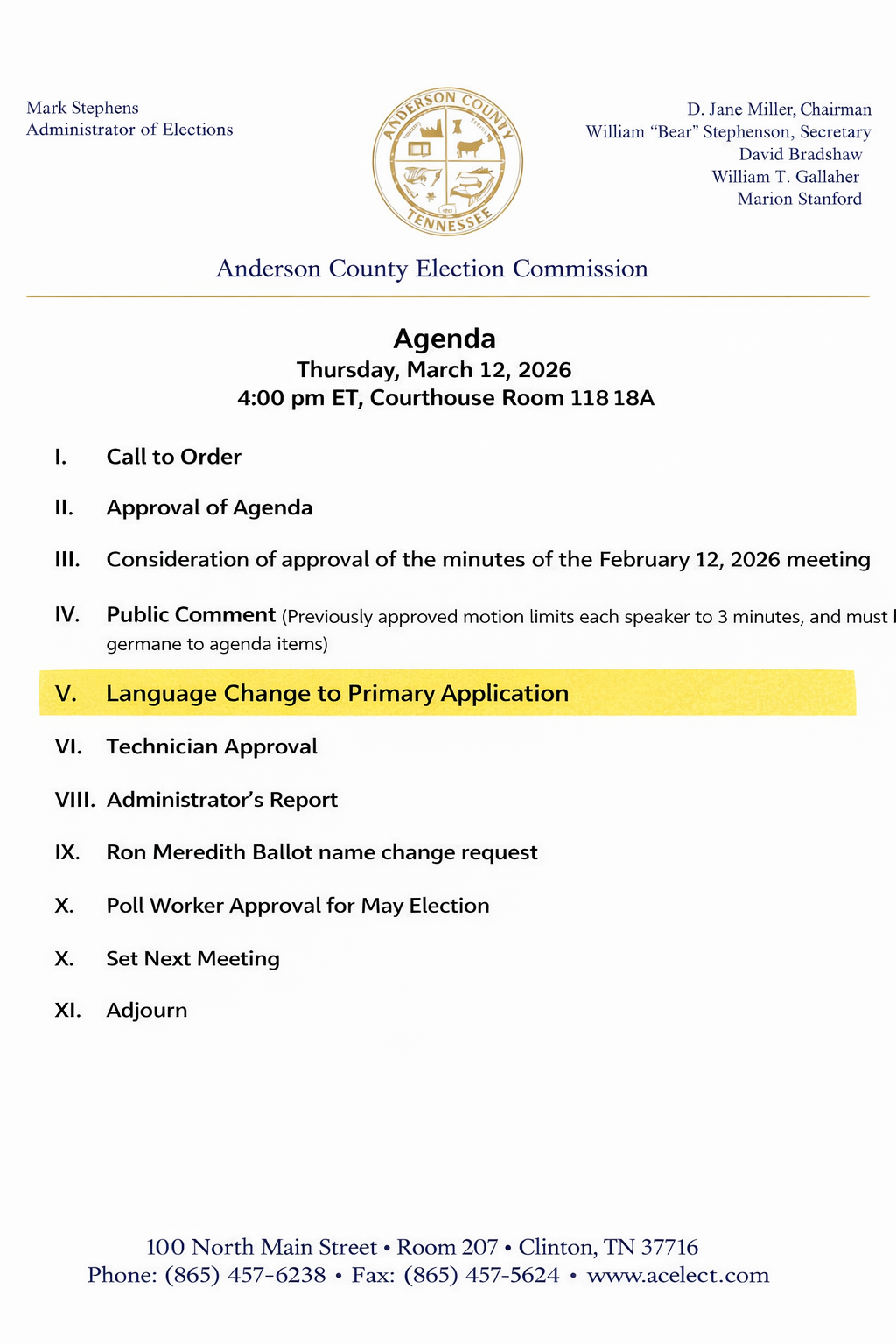
Agenda for the March 12, 2026 Anderson County Election Commission meeting. Item V — “Language Change to Primary Application” — is the only public description of the proposal. No draft language has been released. No one knows who has directed this.
Let’s say the obvious part out loud: Tennessee does not register voters by party.
There is no formal Democratic voter list. There is no formal Republican voter list. There is no clean, public process where a voter signs up in advance and is officially recognized by the state as a member of one party or another.
And yet, if passed, voters would be asked to sign a sworn statement using a term no one seems able to define clearly: bona fide member. That should concern everybody.
Because if the state itself does not track party membership, and if there is no clear public definition of what “bona fide” means for voters, then what exactly are people being asked to swear to?
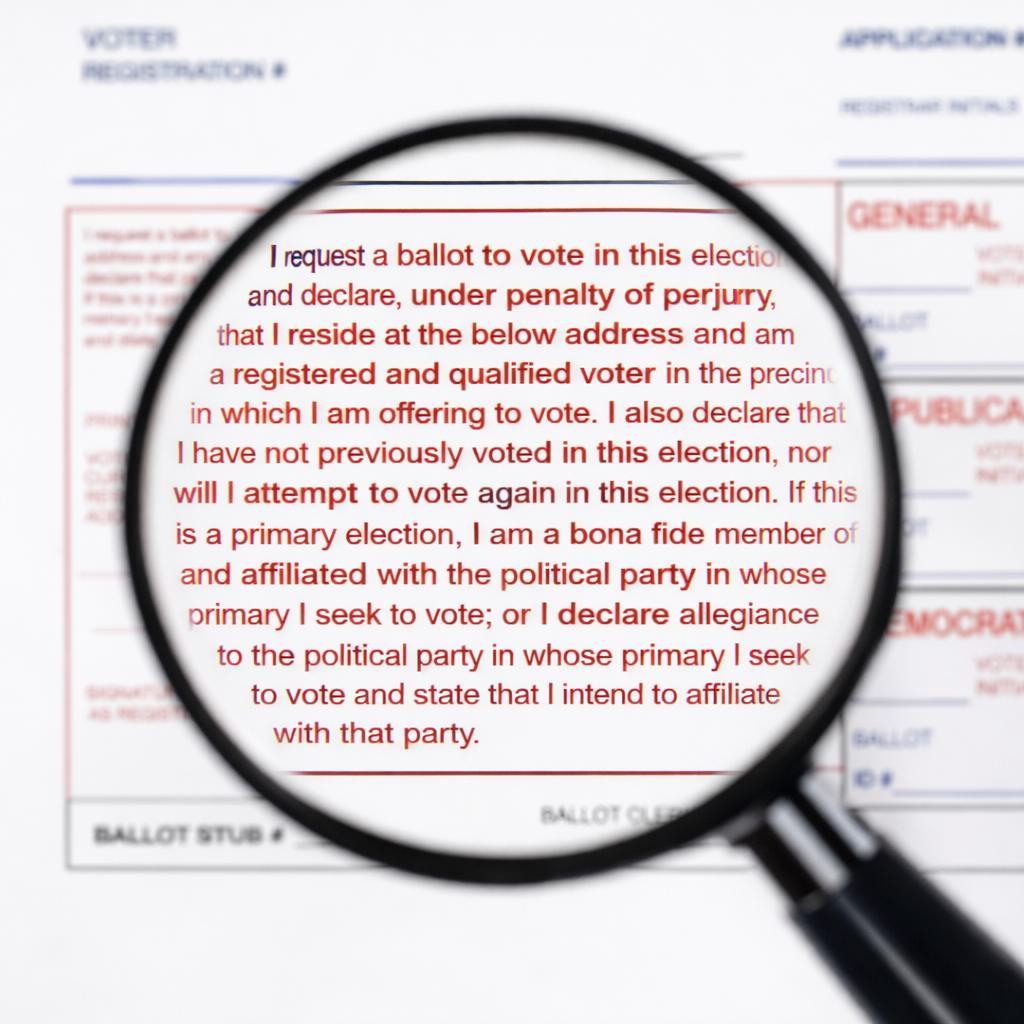
Example wording of a primary participation pledge. Anderson County Election Administrator Mark Stephens has not released the language of the change he is proposing to the public.
That is not a small question.
And it gets worse. The Tennessee Republican Party itself has recently been tangled up in controversy over who counts as a “bona fide Republican” for candidate purposes. Candidates were challenged. Some were kicked off ballots. Some were later put back on. Even party leaders and insiders have struggled to apply the term consistently.
So if a political party can’t even settle on what “bona fide” means for its own candidates, how on earth is an ordinary voter supposed to sign that language under threat of perjury and election-fraud penalties?
To be clear, the Anderson County Democratic Party is not taking this position because of any one Republican primary or any one candidate. This is not about gaming another party’s race. It is not about crossover strategy. It is about something much more basic:
Local election officials should not be moving Anderson County toward a de facto closed-primary system on their own.
If Tennessee wants closed primaries, then Tennessee should debate that openly in Nashville. The General Assembly can pass a law. The state can create a formal system. The state can define the rules clearly and apply them uniformly across all ninety-five counties.
But that is not what is happening here.
Instead, what we appear to be getting is a vague loyalty-style declaration pushed at the county level in a state that still does not have party registration. That is exactly the kind of thing that risks confusing voters, discouraging participation, and undermining trust in election administration.
And unfortunately, this proposal does not exist in a vacuum.
It fits a broader pattern that people in Anderson County have already seen from Mark Stephens: limited public transparency, information arriving at the last minute (if at all), and major matters surfacing without the kind of clear, public explanation voters and commissioners deserve.
At a recent meeting, Stephens also said publicly that he had made a personal promise to a business owner to keep that business as a polling place. That is troubling on its face. Polling-place decisions are supposed to happen through a public process and under the authority of the Election Commission, not through private transcactions from a government employee.
That is one more reason people keep showing up.
And it is also why Chair Jane Miller and the Election Commission cannot simply shrug this off. The commission’s job is oversight. Its job is to ask hard questions before new procedures are adopted, not after. Its job is to protect public trust, not ask the public to trust blindly.
So this is why we show up.
We show up because rules change faster when no one is watching.
We show up because vague legal language has no place between a voter and a ballot.
We show up because if Tennessee wants closed primaries, that decision belongs in Nashville, not in a county office.
And we show up because public trust in elections is too important to leave in the hands of an official who expects the public to just take his word for it.
We’ll see you on the second Thursday of the month. In Room 118 of the Anderson County Courthouse. At 4:00pm.
Have questions? Contact the Election Commission
If you have questions about the proposed language change or believe the public should see the draft language before any vote occurs, you can contact the Anderson County Election Commission members directly.
Chair – Jane Miller
Secretary – William “Bear” Stephenson
David Bradshaw
William T. Gallaher
Marion Stanford
Election Administrator (not a member of the Election Commission) – Mark Stephens
mstephens@andersoncountytn.gov
Transparency builds trust in elections. If the language of a proposed change exists, the public deserves to see it, and know who is pushing it, before it is voted on.