Missing Documents. Delayed Disclosures. Broken Trust: Inside an Anderson County Election Commission Meeting
If you followed Facebook Thursday night after the Anderson County Election Commission meeting, you might think the big story of the evening was a supposed effort to eliminate the Rosedale voting precinct.
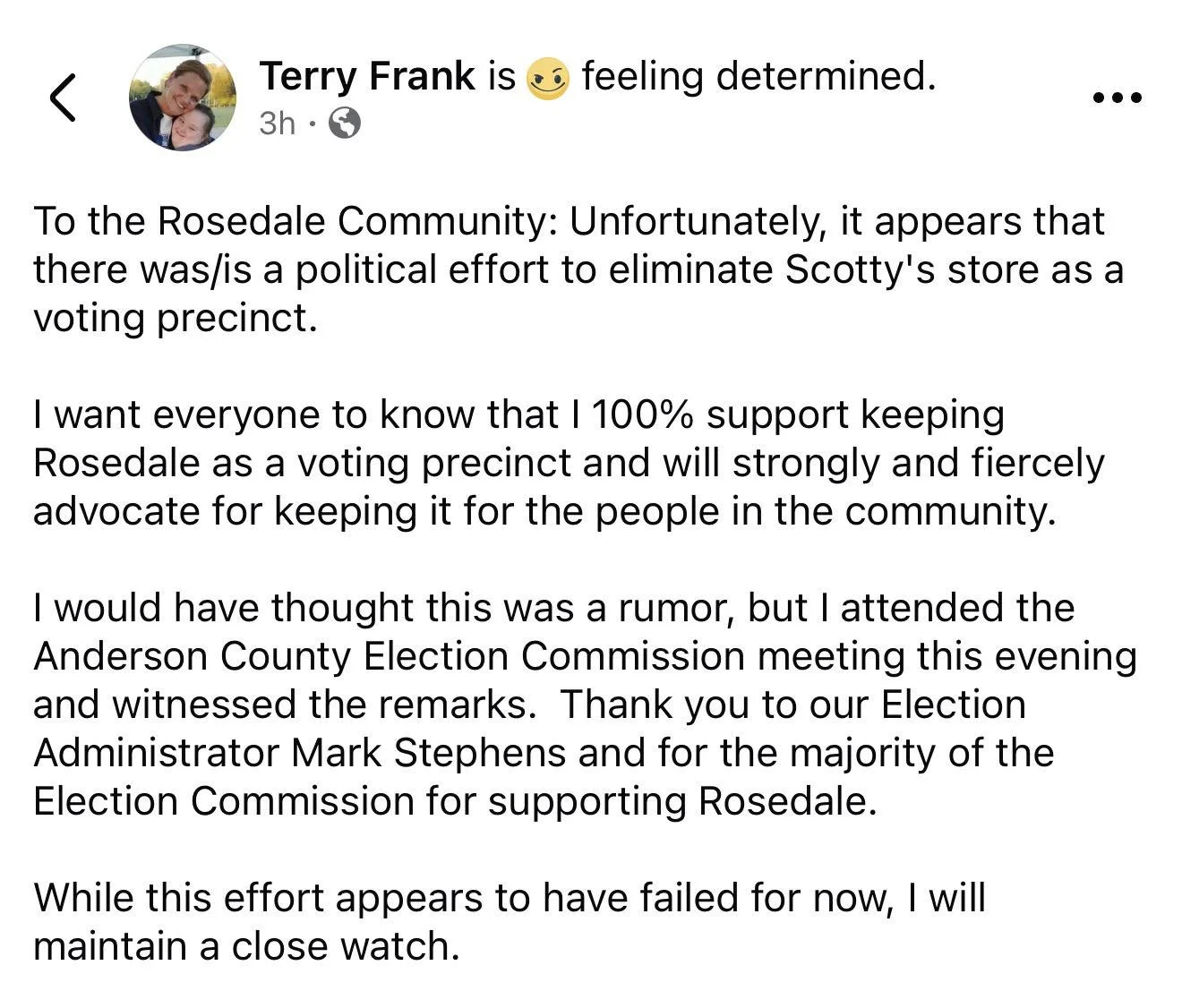
Anderson County Mayor Terry Frank’s Facebook post shortly after the meeting framed the evening around the Rosedale precinct. But that was not the biggest development discussed.
That’s the narrative that started circulating almost as soon as the meeting ended… thank you Mayor Frank… But if you were actually in the room, the biggest story of the night had nothing to do with Rosedale.
The biggest story was this: voters in Anderson County are about to be forced to sign a new political pledge under penalty of perjury when they vote in a primary election, and the Election Commission office had been sitting on that directive for months before the public (and apparently even the commissioners) got a full airing of it.
And that wasn’t the only problem the March meeting exposed. Anderson County has an election office that controls the flow of information, a commission that too often seems to learn things after the fact, and a public that is expected to accept major changes on a basis of “trust me bro.”
That is the real story of the Anderson County Election Commission right now.
Let’s talk about the biggest change in how you will vote in Anderson County… Sign This to Vote. The most significant development discussed Thursday night was the new language voters will now see when requesting a ballot in a primary election.
The language reads:
If this is a primary election, I am a bona fide member of and affiliated with the political party in whose primary I seek to vote; or I declare allegiance to the political party in whose primary I seek to vote and state that I intend to affiliate with that party.
That statement is signed under penalty of perjury (which also leaves you open to election fraud charges post-fact).
For voters, the practical effect is that if you ask for a Democratic or Republican ballot in a primary, you will now be signing a sworn declaration that you are affiliated with (or a bona fide member of) that party or intend to be.
Yes, Tennessee law has long contained party-affiliation language tied to primaries. But Tennessee does not register voters by party. Most voters are used to an semi-open-primary culture where they choose which ballot to request based on the election in front of them. Now that same act comes with a written pledge and a perjury warning printed directly on the application.
That alone would have made Thursday night’s meeting important. But a simple question was asked by the public that put a spotlight on every issue that’s wrong with the Anderson County Election Commission: when did the office get this?
The answer, by the office’s own account, was October.
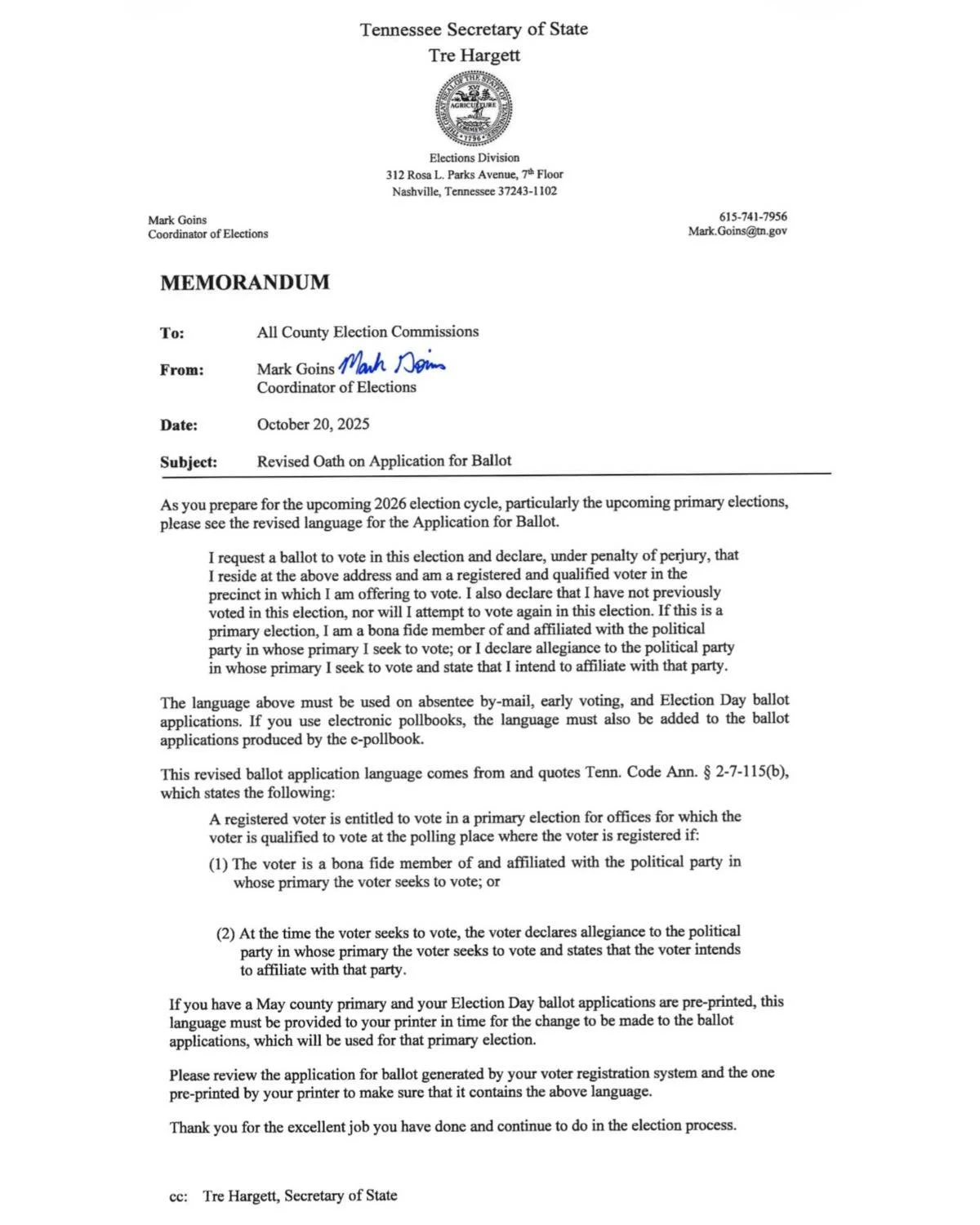
Directive received by the Anderson County Election Office in October. The issue was not publicly discussed by the commission until March… even though it was directed to the Anderson County Election Commission.
Not March. October of 2025.
So a directive affecting how voters encounter the ballot was in the office for roughly five months before it was meaningfully aired in public. And when people asked why, the answer was essentially that the office was waiting for the “appropriate time.”
That answer should bother people. Because election administration depends on trust, and trust does not grow when important changes are held quietly for months and then introduced after the fact.
The new pledge language was not the only issue Thursday night. It was simply the clearest example of a broader pattern.
Again and again, the meeting turned on documents the public had not seen.
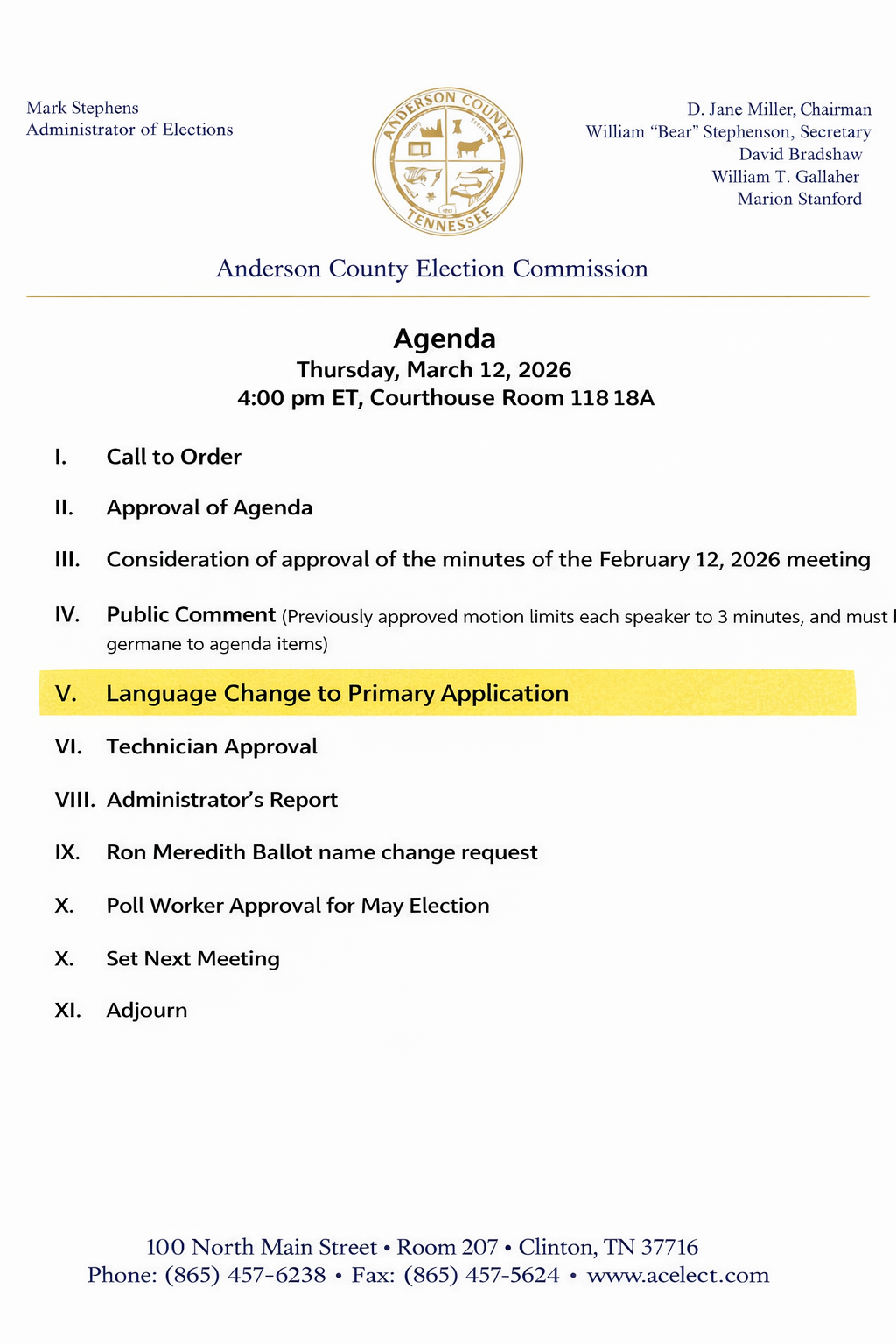
Agenda for the March meeting. “Language Change to Primary Application” was the only public description of the proposal.
Reports were referenced. Memos were referenced. Supporting materialswere referenced. At points, even commissioners appeared to be working from incomplete information or trying to catch up in real time.
That is not a minor process complaint. That is the core governance problem.
When the office controls the documents, controls the agenda flow, controls the timing, and controls the minutes, the office controls the story. And that matters because the Election Commission is supposed to oversee the office… not the other way around.
We’ve written about this before. Back in January, we laid the problem out that the distinction between the commission and the administrator’s office has been blurred. Commissioner Marion Stanford warned then that the public was being funneled through the office and that commissioners were becoming unreachable. Mark Stephens himself described the model plainly: the office gathers and the office “disseminate[s]” the information commissioners need.
That has nothing to do with oversight. That is filtration. Thursday night shwoed exactly what that system looks like in action.
The Minutes Matter Because the Story Matters
Even the fight over the minutes pointed to the same problem.
The commission had to revisit February because language from the prior meeting had not been captured the way some commissioners believed it should have been… including a statement made by Election Administrator Stephens about a “personal promise” regarding a private business.
If the office takes the minutes, controls the records, and then key language disappears or gets softened (or white-washed), the public record itself becomes something citizens have to fight to reconstruct. That is a dangerous place for an elections body to be.
Public trust in elections does not just depend on ballots being counted correctly. It depends on people believing that the officials running elections are being candid, complete, and transparent about what is happening.
Right now, the opposite impression is taking hold.
… And then came Rosedale
By the time the meeting got to Rosedale, the room was already primed. People had already watched a discussion about a major voting change surface months late. They had already watched public transparency concerns brushed aside. They had already watched a body struggle through documents that had not been shared in advance.
So no, Rosedale was not the biggest issue of the night. But it was a perfect example of the larger one.
No one in the room argued that the voters in Rosedale do not deserve a nearby polling place. That was never the issue, despite the Facebook spin afterward.
The real issue was ADA accessibility and what documentation existed to support previous claims about compliance.
That mattered because at the February meeting, commissioners were effectively told they needed to approve precincts based on the office’s account of the situation. A “trust me, bro” model. Commissioner Stanford had already requested, in writing and in person, a copy of the ADA compliance report that Stephens said existed. The document still had not been produced. The explanation, reportedly, was computer problems.
Then, at Thursday’s meeting, Louise McCown (who had been called out by name in the February minutes has having personally approved the location) spoke and made something very important clear: the situation had not been approved in the way it had previously been described. That moment cut straight through the bs if the Election Commissioners were willing to see it.
Because once that claim was challenged in public, the next question became unavoidable: where is the documentation?
Election Administrator Mark Stephens excused himself from the meeting. A short time later, he returned with paperwork related to the ADA issue… documents retrieved from the mayor’s office.
Think about what that means.
A public meeting was actively discussing the legality and accessibility of a polling place, and the relevant paperwork was not already in front of the commissioners, not already in the agenda packet, and not already available to the public. It had to be fetched mid-meeting.
That does not inspire confidence. It reinforces exactly what people in the room were already saying: information is not being shared up front. It is being controlled, delayed, and produced only when pressure forces it into the open.
That pattern showed up again when an Open Records request was handed over during public comment.
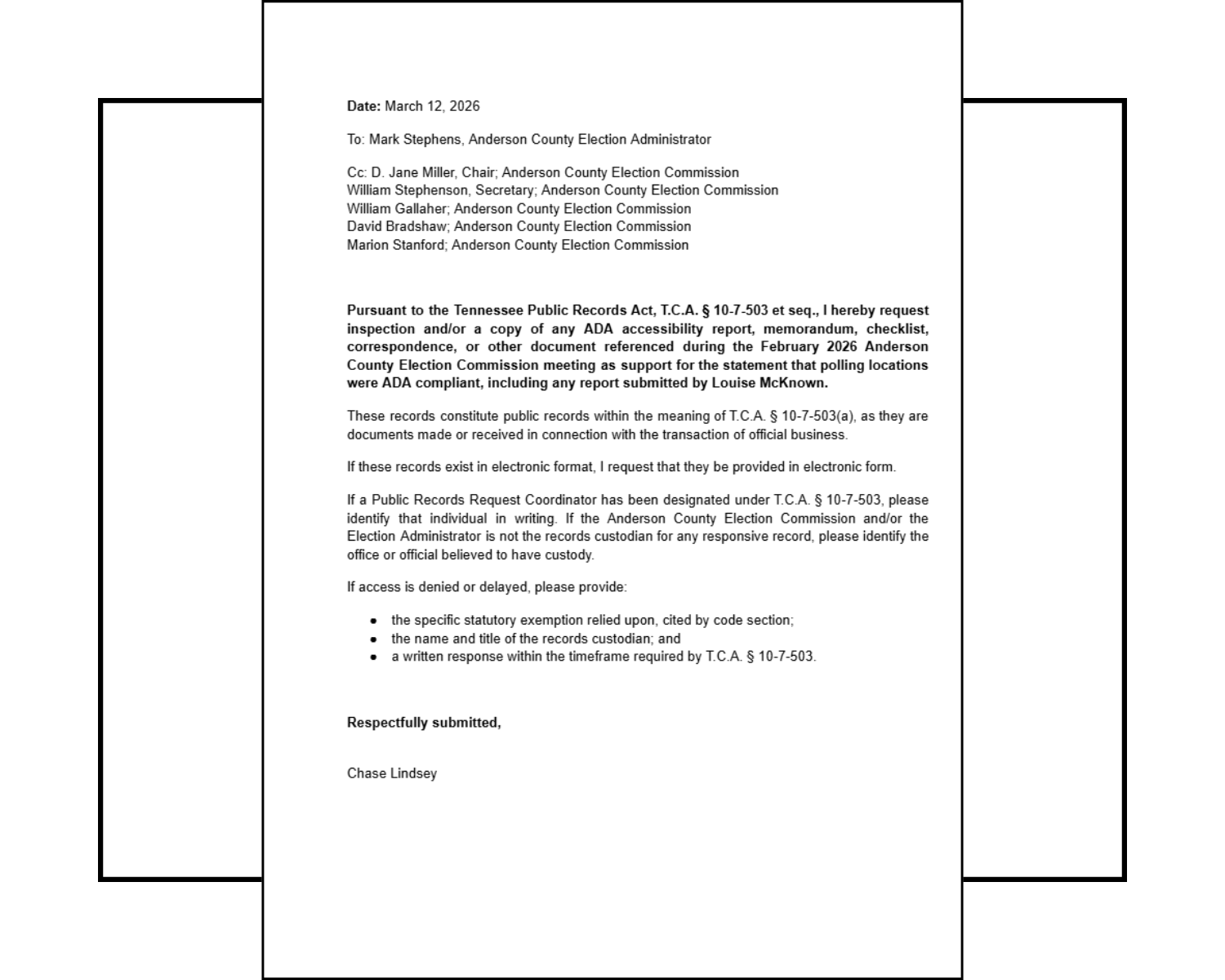
A Tennessee Open Records request submitted during the meeting seeking the ADA compliance report referenced by the office.
Rather than simply accept it and process it, Stephens refused to even take the form directly, saying it was not on him. That is not a small detail.
Because when the public is trying to obtain documents about polling place accessibility, and the response is to deflect responsibility instead of facilitate access, it deepens the central problem: this office behaves as though public access to election information is a burden instead of a duty.
Even the issue of commissioner email addresses fits the same pattern.
Staff members receive county email addresses anytime Administrator Stephens hire someone new (no questions). Commissioners, months after a motion was made to get them official email addresses, still do not have them. The explanation now is cost.
But the result is obvious: communication continues to run through the office. Again, the same pattern. The office as gatekeeper. The office as filter. The office as bottleneck.
If voters cannot easily reach commissioners directly, if records route through the office, if agenda documents route through the office, and if minutes are produced through the office, then the office has far too much control over a body that is supposed to supervise it… That is the larger story here, and it keeps showing up meeting-after-meeting-after-meeting-after-meeting.
So what did Thursday night actually show?
By the end of the meeting, three things were clear.
First, the most immediate change affecting voters was the new primary-election pledge signed under penalty of perjury.
Second, there was no motion, no vote, and no proposal to eliminate the Rosedale precinct.
Third, the Anderson County Election Commission Administrator’s Office continues to operate in a way that leaves the public (and at times even the commissioners themselves) in the dark until someone starts asking hard questions.
That is not how election oversight is supposed to work.
An elections body cannot run on missing documents, delayed disclosures, verbal assurances, and after-the-fact cleanup. It cannot run on a trust me process when the trust has already been spent. And it cannot keep functioning as a body where the office holds the information, the commissioners play catch-up, and the public is expected to take whatever version of events they are handed.
That is where Anderson County is. And that is why people keep showing up.
Because if the public is not in the room, too much happens quietly, too late, and with too few answers. And when public trust is treated like an inconvenience, public scrutiny becomes the only thing left.
The Anderson County Election Commission meets on the second Thursday of the month at 4:00pm in room 118 of the Anderson County Courthouse.
Have questions? Contact the Election Commission
If you have questions, you can contact the Anderson County Election Commission members directly. The Election Administrator doesn’t want you to, but it is your right.
Chair – Jane Miller
Secretary – William “Bear” Stephenson
David Bradshaw
William T. Gallaher
Marion Stanford
Election Administrator (not a member of the Election Commission) – Mark Stephens
mstephens@andersoncountytn.gov
Transparency builds trust in elections. If the language of a proposed change exists, the public deserves to see it, and know who is pushing it, before it is voted on.