The District 8 Vacancy Wasn’t a Mystery. So Why Are Terry Frank and Denise Palmer Making It One?
My name is Chase Lindsey, and I serve as Chair of the Anderson County Democratic Party.
Most of what people see from that role is the political part: candidates, volunteers, signs, meetings, knocking doors. There is another part that happens mostly out of sight. Political parties have a formal role in Tennessee’s election process, and every so often that means dealing with qualifying deadlines, vacancies and unusual situations where getting the process right matters just as much as getting a candidate elected.
That is how I ended up involved in the vacancy on the Anderson County Commission in District 8.
During Monday night’s County Commission meeting, County Law Director Jamie Brooks was asked who first contacted him as questions emerged about how that vacancy should be handled. His answer was the chairman of the Anderson County Democratic Party… That was me.
And because that contact was raised publicly while Commissioner Denise Palmer questioned whether the vacancy existed, how the race reached the November ballot and whether County Commission was being asked to approve something after the fact, I think the full record should be public too.
The Democratic Party did not decide that District 8 had a vacant seat. We did not decide that another election should be held in November. We became involved because we learned that someone elected in August did not intend to assume office when the new term began September 1, and suddenly one legal question mattered a great deal:
When, exactly, did that office become vacant?
The answer would determine everything that followed.
So before we announced a caucus, before we had a candidate and before there was a campaign for this seat, we tried to answer it.
… Y’all, we did our homework.
It started September 1
Liz Henry had been elected August 6 to one of District 8’s two County Commission positions. When the new Commission met on September 1, Henry did not appear to be sworn in with the other successful candidates.
Almost immediately after Robert McKamey was elected Commission chairman at that special-called meeting, County Mayor Terry Frank raised what she described as a constitutional question over whether a vacancy existed at all. The county had publicly noticed that September 1 meeting for the election of Commission leadership and organization of the new term.
Frank told commissioners she had written the county law director and the district attorney general about the issue.
Then she stated her position:
“I don’t believe a vacancy exists.”
Frank argued that Henry had communicated an intention not to take the oath rather than submitting what Frank considered a resignation, and that County Commission had authority to address the vacancy.
That was not a minor parliamentary disagreement. The date on which the vacancy existed determined what happened next.
Our party had already begun looking at that question. I had spoken with Brooks and then followed that conversation in writing, laying out the issue we believed controlled the entire process: was this the resignation of an officeholder, or the failure of a commissioner-elect to qualify for an office she had never assumed?
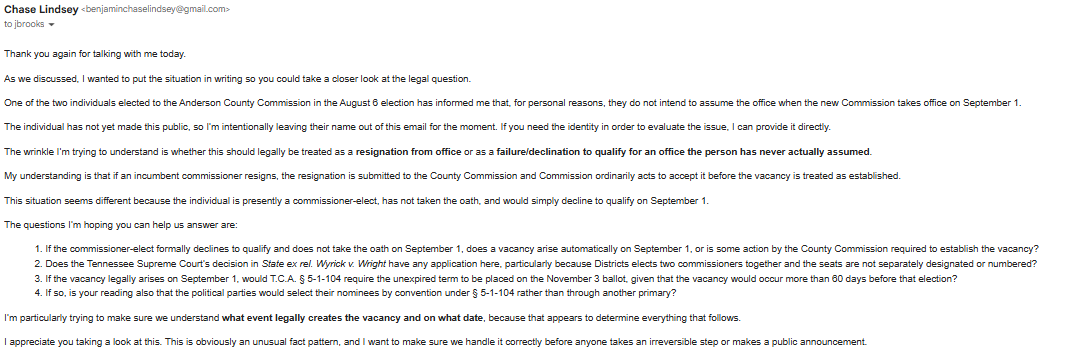
Email sent to Jamie Brooks at 1:27 PM on August 27th, 2026
We pointed him to State ex rel. Wyrick v. Wright, a 1984 Tennessee Supreme Court case involving a member elected to a multi-member legislative body who never took the required oath. The Court held that an elected officer who had not taken a required oath had not qualified for office, and that in a multi-member body where the position could not be tied to a specific holdover incumbent, the office became vacant when the new term began.
That matters here because District 8 elects two commissioners together. Voters do not elect one person to “Seat One” and another to “Seat Two.”
We also asked Brooks what a September 1 vacancy meant under Tenn. Code Ann. § 5-1-104. That statute provides that when a county-office vacancy occurs less than sixty days before the August election but at least sixty days before the November election, party nominees are selected by convention and a successor is elected in November. The statute separately recognizes that County Commission is not required to make the usual appointment when a general election is already scheduled and there is sufficient time to place the vacancy on that ballot.
September 1 was 63 days before November 3.
The Attorney General had also previously addressed this part of the election calendar. Opinion 08-138 is titled “Vacancy on Knox County Commission,” and the Attorney General’s published opinions also include Opinion 08-130 on political-party nominations.
Our email to Brooks did not ask him to bless something the party had already decided to do. It said explicitly that we wanted to understand “what event legally creates the vacancy and on what date,” because that answer appeared to determine everything that followed.
We also told him why we were being careful: we wanted to get it right before anyone took an irreversible step or made a public announcement.
The party did not start with a candidate and go looking for a legal theory.
We started with the legal question.
By 3:24 that afternoon, every member of County Commission had received an email explaining what we had learned.
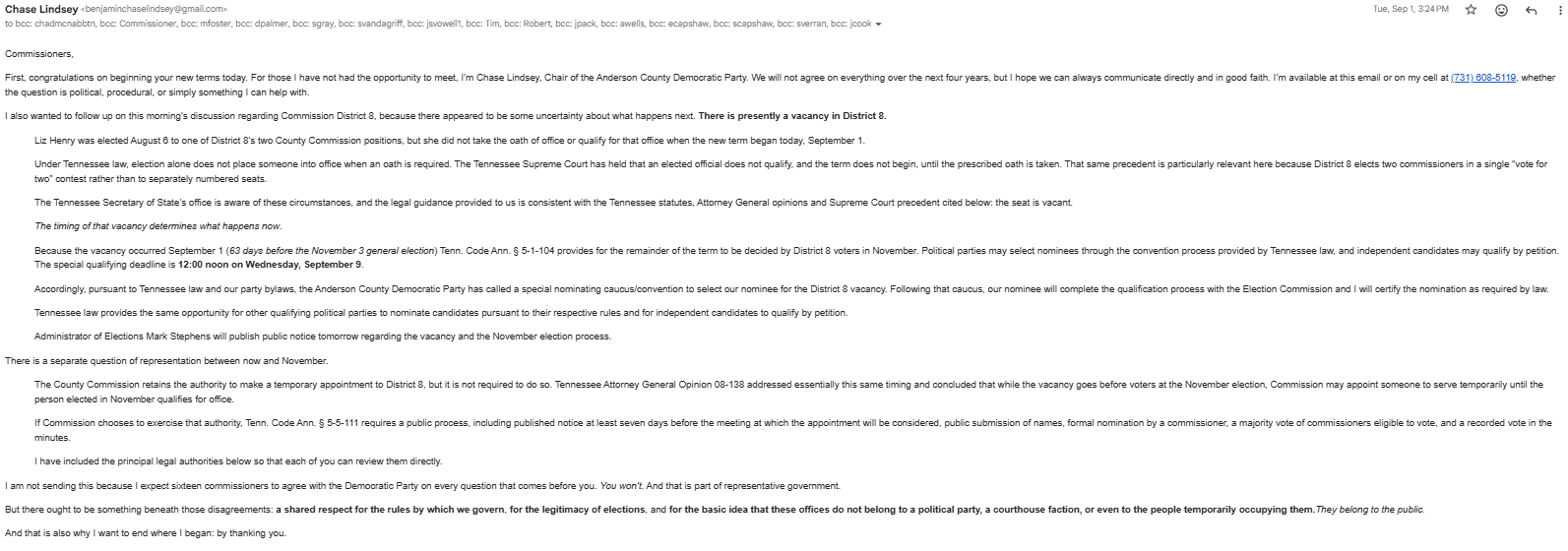
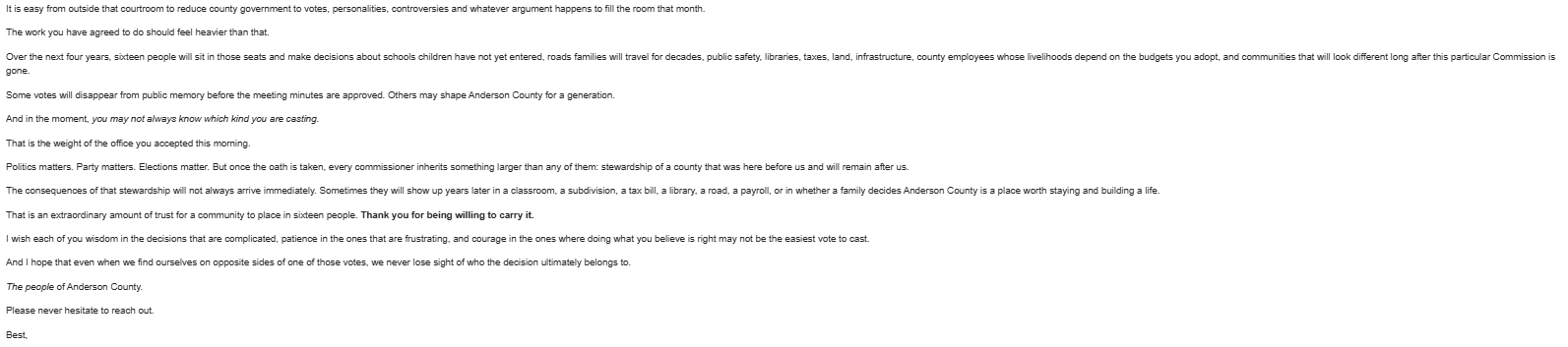
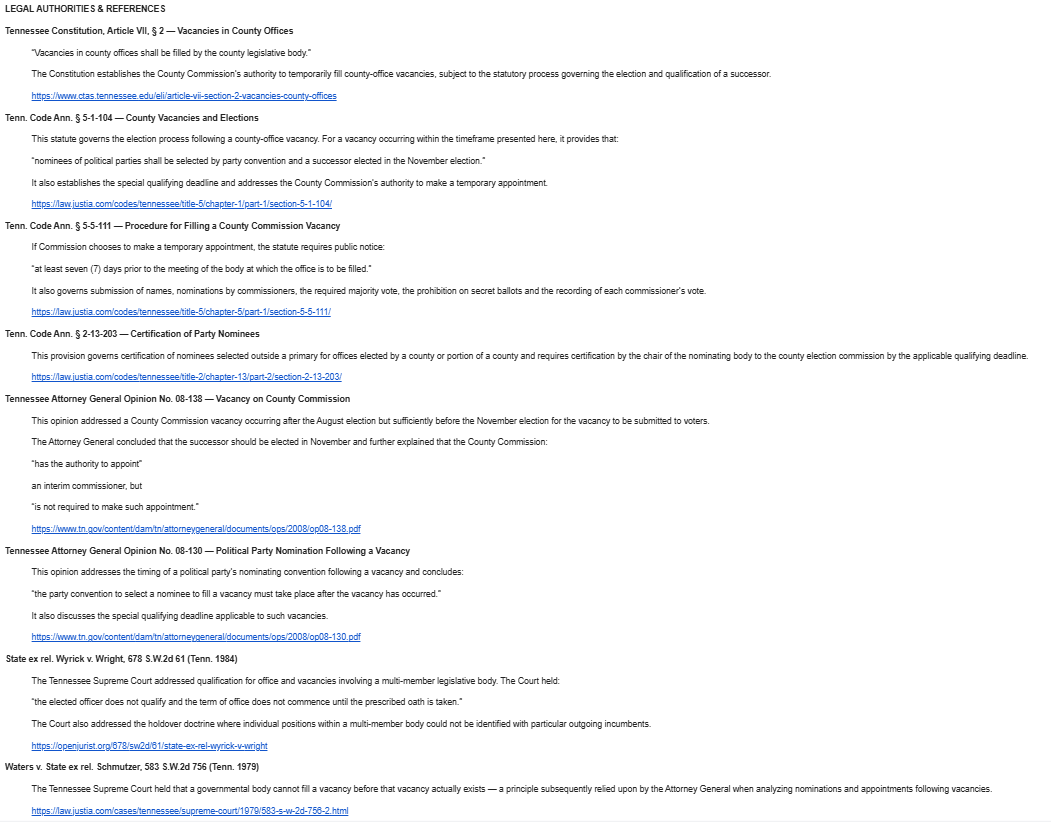
Its first substantive sentence was straightforward:
“There is presently a vacancy in District 8.”
The email explained the September 1 vacancy date, why the timing placed the remainder of the term on the November ballot, how party nominations would work and the separate authority County Commission retained to make a temporary appointment until the elected successor qualified. The statutes, Attorney General opinions and Tennessee Supreme Court precedent were included so commissioners could check the work themselves.
The November election and a temporary appointment by County Commission were not the same process.
The vacancy and its timing put the election process in motion. Commission separately retained the ability to temporarily fill the empty seat while that election played out.
Once we were satisfied that we understood our responsibility, we carried it out.
On September 4, District 8 Democrats gathered publicly in Oak Ridge for a nominating caucus. Several Democrats sought the nomination. Credentialed District 8 Democrats voted, and Gina Grubb was selected as the Democratic nominee.
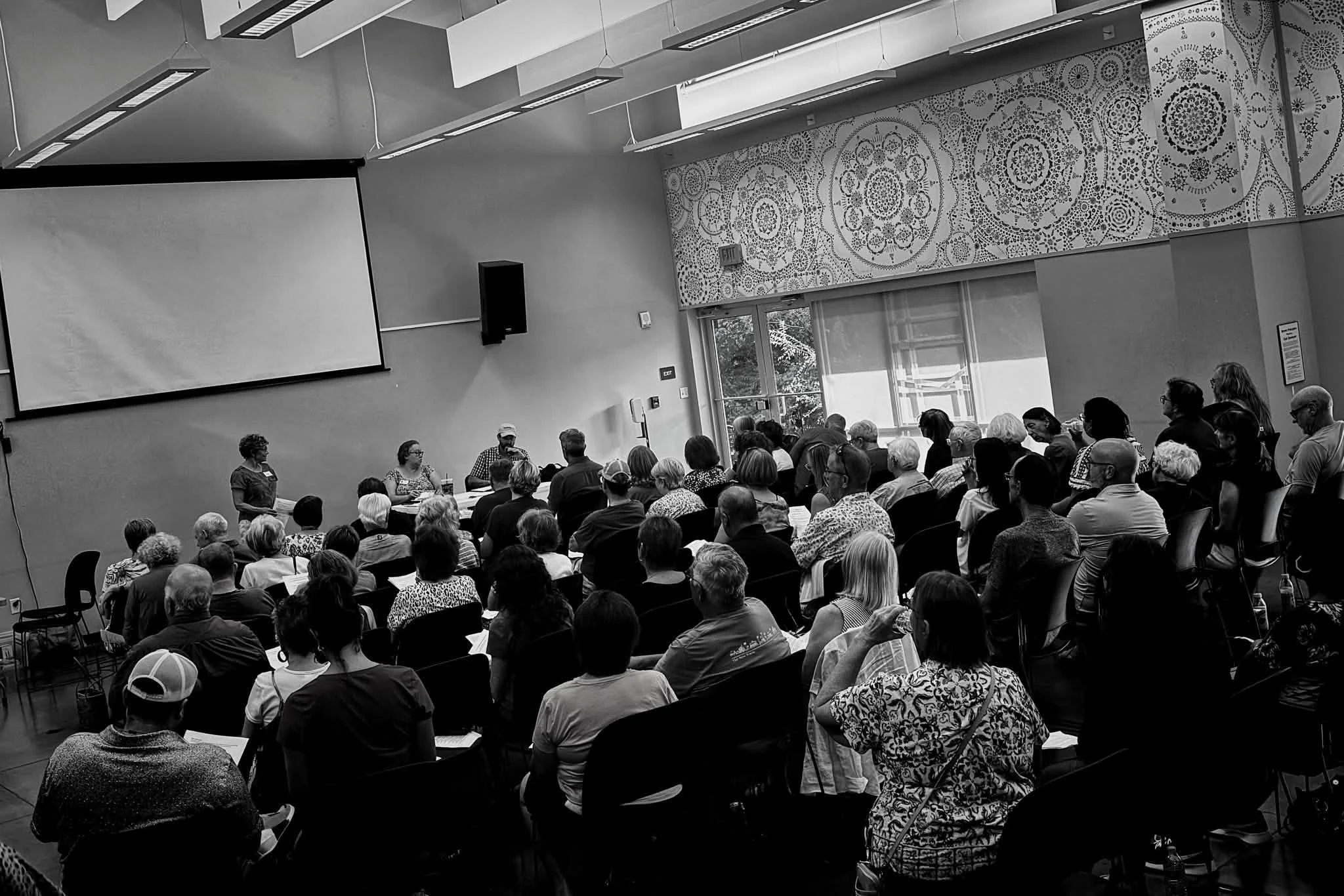
It was not a backroom appointment. It was a public caucus held specifically because Tennessee law called for the party to nominate a candidate by convention. Local reporting documented both the caucus and the special election already underway.
Republicans later held their own convention and nominated Don Layton. Election officials accepted the nominations, and the race proceeded.
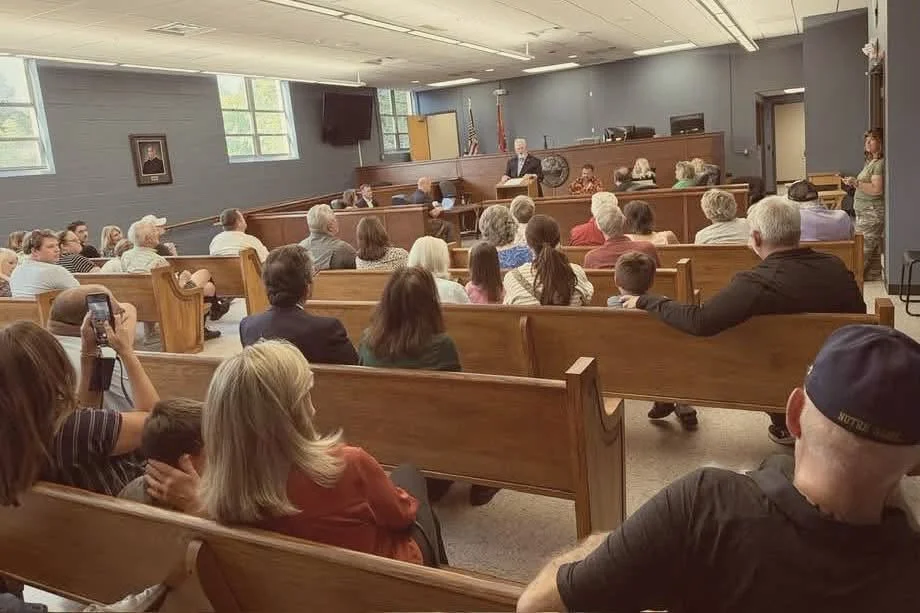
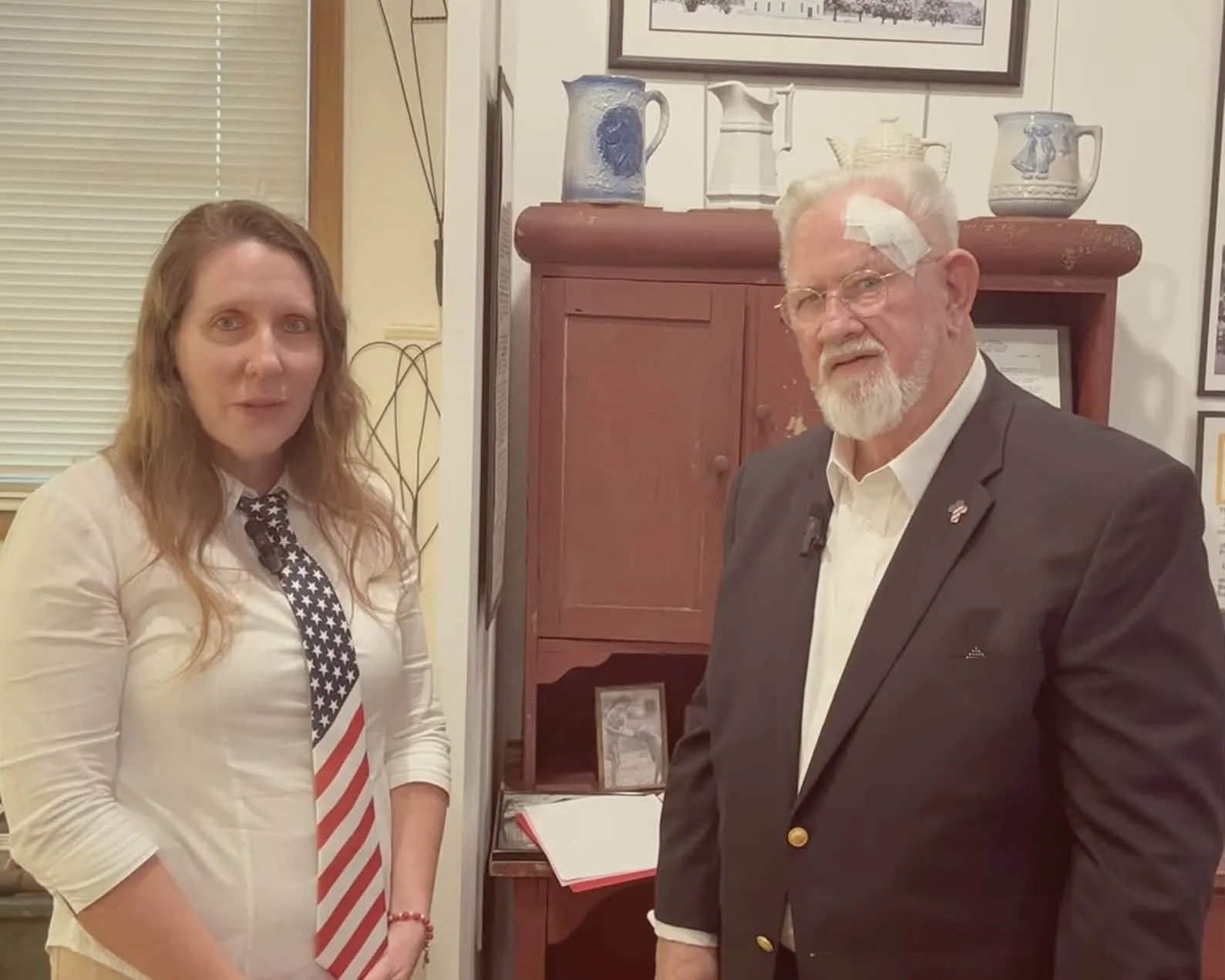
Don Layton with right-wing school boar member Deb Heaton.
By September 2—before either party had selected a nominee—Election Administrator Mark Stephens had already publicly confirmed that qualifying had opened and told The Courier News, “by state law, we must hold a whole new election.”
Then came September 21.
Three weeks after Terry Frank told Commission she did not believe a vacancy existed, Palmer began asking whether Anderson County actually had a vacancy at that moment or whether one would exist only after County Commission acted.
Brooks answered:
“You had a vacancy as of 12:01 a.m. September 1.”
He added that the vacancy had not been filled and remained open.
Palmer then asked who had made the decision to put the race on the November ballot. She was told the Election Commission.
She asked whether there was Tennessee law supporting that decision. Brooks explained that election officials had the relevant information and that Stephens had been communicating with election attorneys in Nashville.
Palmer said the sequence felt like the county had gotten “the cart before the horse.”
She said Commission’s action felt like a “rubber stamp.”
Later, she said commissioners had been “kind of kept in the dark” and had learned what was happening through social media and word of mouth.
Chairman McKamey pushed back, recalling that the law director had informed Commission on September 1 that a vacancy existed. Palmer disputed his characterization of what could have been discussed during that special-called meeting.
Whatever anyone remembers about conversations around the courthouse that day, there is also a written record.
Every commissioner received the September 1 email.
The vacancy was explained… The election process was explained.
Commission’s separate temporary-appointment authority was explained.
And the underlying law was attached.
That is why we take the discussion Monday night seriously.
We did contact Jamie Brooks. That is not something we are embarrassed about or interested in distancing ourselves from. The Democratic Party had a legal responsibility to determine whether it needed to hold a convention, and very little time in which to make that determination. Researching the law, identifying the legal question, taking it to the county attorney and waiting until we understood the answer before acting is exactly what a responsible political party should have done.
What concerns us is what happens when the same uncertainty is repeatedly introduced after the process has already been researched, documented and carried out.
Frank publicly said on September 1 that she did not believe a vacancy existed.
The Commission received the legal basis for the vacancy and the process that afternoon.
The Election Commission opened qualifying.
Both parties held conventions. Candidates qualified.
Then, three weeks later, Palmer again questioned whether the vacancy existed, who put the election on the ballot and whether Commission was being asked to rubber-stamp something that had gotten ahead of it.
Whatever the reason for those questions, their effect is the same: they cast doubt on whether an election already underway got there legitimately.
The record matters because the people of District 8 should not have to sort through insinuation to figure out whether the election on their ballot belongs there.
The vacancy existed when the new term began. The timing of that vacancy triggered the November process laid out in Tennessee law.
County Commission’s authority to make a temporary appointment was a separate matter.
Anderson County’s own law director ultimately put the first point in the clearest possible terms: the vacancy existed at 12:01 a.m. September 1.
That should not become more confusing every time it is discussed.
And now District 8 has a choice
All of this procedure ultimately leads somewhere very simple: District 8 voters now have two candidates in front of them on November 3, Republican Don Layton and Democrat Gina Grubb. Early voting runs October 14 through October 29.
Layton is not a new name on the ballot. He served for years as an Anderson County General Sessions judge before losing the 2022 Republican primary to Victoria Bowling, 57% to 43%. He then ran for District 8 County Commission this August and finished third behind Liz Henry and Jawrell Cook.
After Henry declined to take office, Republicans selected Layton for another chance at the seat. In his acceptance speech, Layton talked about “traditional family values.” He was the only candidate seeking the Republican nomination, and after the caucus a Republican official remarked… “he’ll have to do.”
And voters do not have to guess what Layton means when he talks about the cultural issues he wants to bring to County Commission. His own campaign material says he wants to “stand against pornographic and pedophilic indoctrination in schools & public institutions.” Another election graphic says children “must be protected from evil” and that while he supports the First Amendment, he does not support “materials that indoctrinate our children.”


Those are his words.
Gina Grubb comes to the race from a different background and with a different set of stated priorities. She grew up in Oak Ridge, spent nearly fifteen years with the Oak Ridge Police Department and later worked in education as a STEM and math teacher.



In talking about what she wants to bring to County Commission, Grubb has emphasized transparency, communication with residents and accountability in county government. She has said she wants residents informed when important issues come before Commission, wants their feedback, and intends to scrutinize waste and misconduct while approaching decisions with what she described as “reason, wisdom, and compassion.”

That is the choice now in front of District 8.
Layton is returning to the ballot after losses in both his 2022 judicial race and this August’s Commission election, and his current campaign has put “traditional family values” and claims about indoctrination in schools at the center of its message. Grubb is running on transparency, accountability, communication and a public-service background that includes both law enforcement and education.
The special election exists because Tennessee law put the vacancy before District 8 voters.
Now those voters get to decide what kind of representation they want.
That is where this process was always supposed to end: not with Terry Frank deciding who fills the seat, not with County Commission choosing the remainder of the term, and not with either political party getting the final word.
With the voters.
Early Voting for the November election is October 14-29
Election Day is November 3rd.